


IMAP, MAPI, ActiveSync…: the hidden languages behind your emails

Email is still the most widely used business tool. Behind the “clients” — the applications you open every day like Outlook or mobile mail apps — lies a set of protocols and formats that make everything work: delivering messages, syncing calendars, sharing contacts. Invisible to end users, these languages define not just the experience, but […]
Business Continuity Planning and Disaster Recovery Planning : reliability for your business emails

Focus on BlueMind’s work to ensure that users do not experience any disruption to their email service, even during updates or technical changes.
Securing BlueMind 4.7 with a Let’s Encrypt certificate

In BlueMind, from version 4.7, everything to do with certificate management is automatic and natively supported: creation, installation and, most importantly, renewal. Once it is set up, you can forget about certificates and let BlueMind handle things.
Migrate your Exchange email to BlueMind

How to prepare and realize your migration to BlueMind from Exchange: all the BlueMind tools and support you”ll need to succeed
Governments, major organisations and sovereignty: promises and contradictions

BlueMind has developed a software infrastructure and tools to manage tens of thousands of email users in a smooth and resilient way. But this is only the tip of the iceberg…
Inside a software publisher’s workshop: new in BlueMind and ongoing projects – part.2

Halfway through this atypical year, we thought we’d take stock of BlueMind’s latest features and ongoing development areas in a two-part series. Here is the second and final part of our journey into BlueMind’s production workshop (read part 1 again). The core of our activity is about improving and consolidating our solution – a task […]
Inside a software publisher’s workshop: new in BlueMind and ongoing projects – part.1

The first half of 2020 has come with its share of surprises. Many of us have experienced remote work for the first time, changed work habits and everyday tools and altered the way we previously organised our activities to online collaboration. Email has more than ever risen as the oxygen of digital communications. From the […]
The steps to a successful business email migration

If you follow this blog (and if you don’t we strongly recommend that you do!), you already know how critical email is to a business. It remains the most used means of communication despite fierce competition from other tools. Recent events have been yet another reminder of this: massive remote work as a result of […]
Industrialising the installation of BlueMind with Ansible

Installing a BlueMind platform is typically straightforward, involving few steps once the architecture is defined. In some cases, however, installation needs to be industrialised in order to be played several times. This may be needed, for example, for hosts or clients with a large number of users and several platforms. Ansible is an automation engine […]
BlueMind Core, an innovative architecture that adapts to all uses
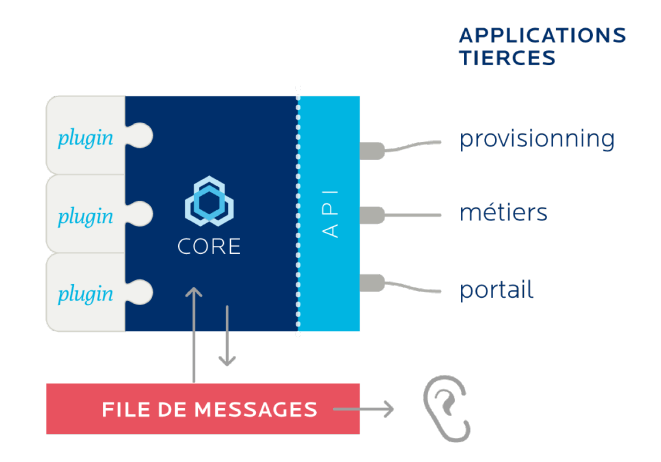
DESCRIPTION of CORE V2’s architecture BlueMind’s 2nd generation Core is a Java program. It exposes web services representing BlueMind’s API. It runs scheduled tasks (back-ups, re-indexing, directory synching, reporting). Core is the only component that handles the data from PostgreSQL databases. All other components pass through it to read and edit information. It receives http requests […]